Society of Schnappatmung
David Schiesser
Jun 5th – Jul 17th 2026


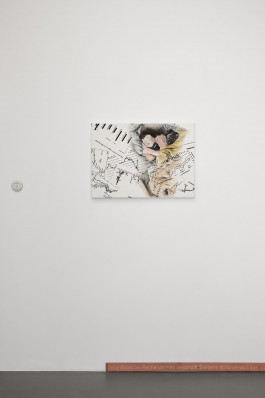
Käthe verschläft KI-Bubble
2026
52 × 72 cm
Silkscreen and oil on canvas


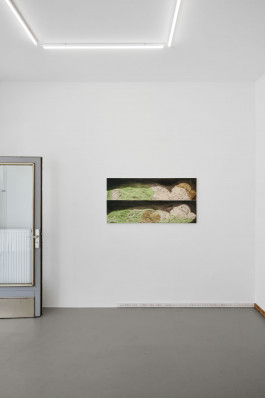
Horizontal Office
2026
60 × 120 cm
Oli and ink on canvas

Säger & Jammler
2026
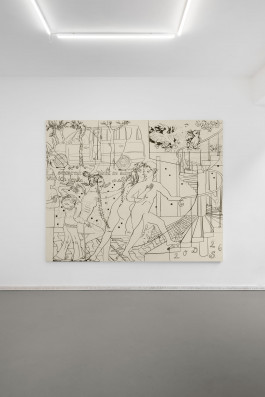
200 × 250 cm
Charcoal on canvas


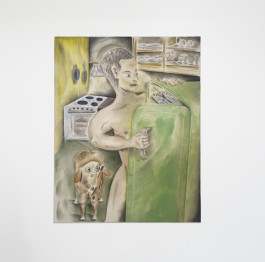
Singlehaushalt
2026
50 × 40 cm
Oil on canvas

The Day We Set Foot On Land Should Be A Public Holiday
2026
64,5 × 53,8 cm
Oil on canvas

Import / Export
2026
90 × 160 cm
Oil on canvas

Fleischwurstring
2026
125 × 72 cm
Oil on canvas


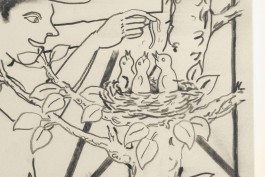
The Feeder
2026
200 × 80 cm
Charcoal on canvas

Gruß in die Baumkronen
2026
60 × 90 cm
Oil on canvas
Fis(h)cal Projections
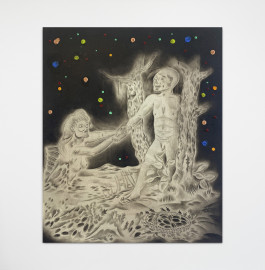
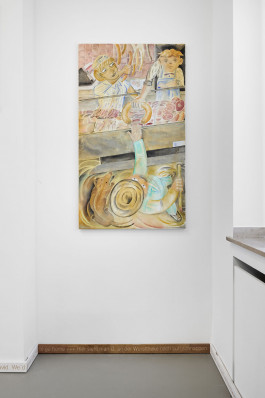
The year is 3027. A futuristic sea nymph crests the ocean: breasty, gilly, and moustached, her hands outstretched in a dual gesture of greeting and cajolery. She grasps the nearest living creature, a semblance of a man whose cranium has swollen over the aeons, their entwined limbs spanning evolutionary time. Philosophers have long speculated on what it would mean to survive a thousand years into the future. What kind of language might endure? What symbols could persist? What shared understanding could these two creatures have, divided by land, sea, and biology itself? Under sugared stars, only one item seems to have resisted the evolutionary impulse: the man’s flip-flops.
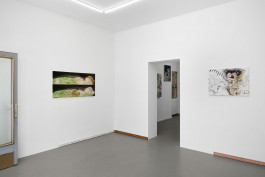
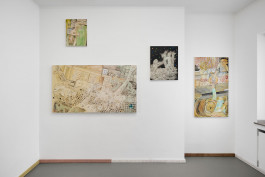
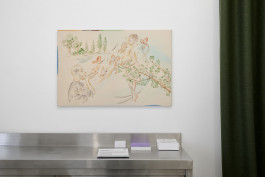
‘The Day We Set Foot On Land Should Be A Public Holiday’ belies an escapist tendency endemic to David Schiesser’s Society of Schnappatmung, an exhibition in which contemporary anxieties – fiscal, bodily, organic, fantastical – are imagined, played out, and repeatedly undermined by the interminable banal. Using the lexical fields of the evolutionary, commercial, agricultural, and medieval, the artist’s work spans alpine cattle parades, fiscal projections, the butchers, and several, unnameable in-between locales. Much like world-building, in Schiesser’s work pockets of ideas proliferate within the same loose, organic universe. Working across charcoal drawing and oil painting, some works are stark, like ‘Horizontal Office’ – a diptych depicting the inability to stop thinking when lying awake at night, its composition eerily coffin-like – while others have a surprising tenderness –‘Käthe verschläft KI - Bubble’ depicts the artist’s daughter peacefully sleeping, blissfully unaware of silkscreen financial graphs underneath.
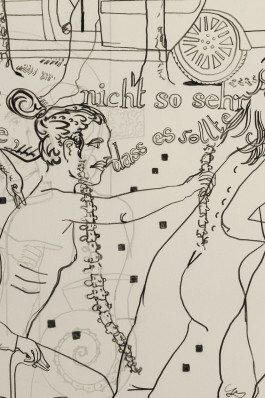
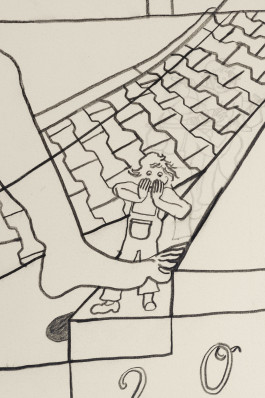
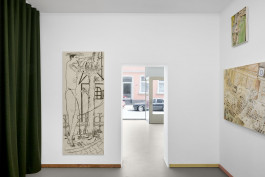
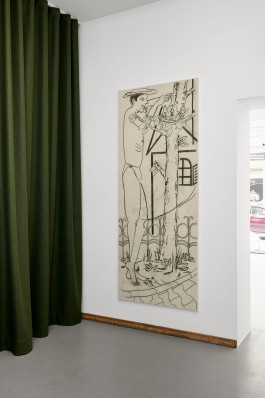
Like a possessed hand in a séance, Schiesser’s use of line seems to move faster than consciousness, with compositions that produce dream-like, associative modes of relation. In the large-scale charcoal work, ‘Säger und Jammler’, nude figures prepare to ascend a staircase, their composition inviting visual parallels to The March of Progress. The work suggests an eschatological circularity, with figures arriving via people-mover and ascending up stairs where cormorants abound. Different elements jostle for visual eminence, which has the narrative density of a Bosch painting; the medieval tumult of a Chaucerian text. Each successive figure proffers a spine, amongst which a textual outline drifts: Es schmerzt nicht so sehr wie ich denke dass es sollte – a line recontextualised from a fantasy novel, and also used to reference Vilém Flusser’s ideas about verticality and human progress. Here, the contemporary response is a kind of cynical yet joyful inevitability.
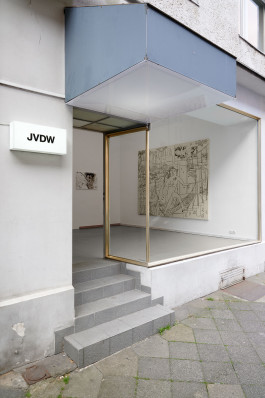
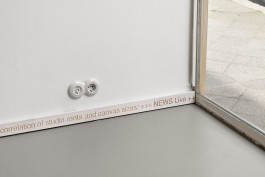
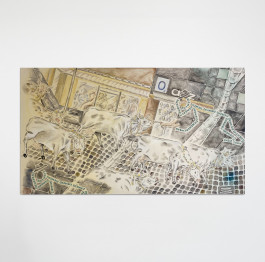
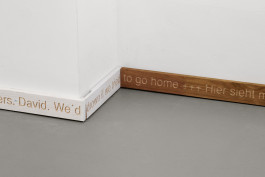
In other works, text juxtaposes economic and agricultural domains: in the iridescent painting ‘Import/Export’ against the backdrop of a procession of cattle through an alpine village, the brand Siemens hovers in the silhouette of a crawling, invisible man. Schiesser’s use of word-as-image, both here and in ‘Säger und Jammler’, recalls the banderole, a kind of medieval speech bubble employed by scribes and painters not only to render spoken language visible, but also as moralising commentary. Its use here renders the work parable-like. The word Schnappatmung, which is translated for me verbally as a series of theatrical gasps and sharp inhales, feels apt for an exhibition reckoning with teeming sensory input and contemporary stimulation, futility and abundance, restlessness and the carnivalesque. This feeling is underlined physically at JVDW gallery, where financial information lines the walls like a news-ticker: just in! Like the thoughts of a society on its last legs, Schiesser’s work is coloured with the fantasies, paranoias, and desires of those still inhabiting it, posing questions about our place and ultimately trajectory in the world.
Text: Lydia Earthy
Photography: Mareike Tocha

Photography: Paul Mecky
Society of Schnappatmung
David Schiesser
Jun 5th – Jul 17th 2026


Käthe verschläft KI-Bubble
2026
52 × 72 cm
Silkscreen and oil on canvas


Horizontal Office
2026
60 × 120 cm
Oli and ink on canvas

Säger & Jammler
2026
200 × 250 cm
Charcoal on canvas


Singlehaushalt
2026
50 × 40 cm
Oil on canvas

The Day We Set Foot On Land Should Be A Public Holiday
2026
64,5 × 53,8 cm
Oil on canvas

Import / Export
2026
90 × 160 cm
Oil on canvas

Fleischwurstring
2026
125 × 72 cm
Oil on canvas


The Feeder
2026
200 × 80 cm
Charcoal on canvas


Gruß in die Baumkronen
2026
60 × 90 cm
Oil on canvas
Fis(h)cal Projections
The year is 3027. A futuristic sea nymph crests the ocean: breasty, gilly, and moustached, her hands outstretched in a dual gesture of greeting and cajolery. She grasps the nearest living creature, a semblance of a man whose cranium has swollen over the aeons, their entwined limbs spanning evolutionary time. Philosophers have long speculated on what it would mean to survive a thousand years into the future. What kind of language might endure? What symbols could persist? What shared understanding could these two creatures have, divided by land, sea, and biology itself? Under sugared stars, only one item seems to have resisted the evolutionary impulse: the man’s flip-flops.
‘The Day We Set Foot On Land Should Be A Public Holiday’ belies an escapist tendency endemic to David Schiesser’s Society of Schnappatmung, an exhibition in which contemporary anxieties – fiscal, bodily, organic, fantastical – are imagined, played out, and repeatedly undermined by the interminable banal. Using the lexical fields of the evolutionary, commercial, agricultural, and medieval, the artist’s work spans alpine cattle parades, fiscal projections, the butchers, and several, unnameable in-between locales. Much like world-building, in Schiesser’s work pockets of ideas proliferate within the same loose, organic universe. Working across charcoal drawing and oil painting, some works are stark, like ‘Horizontal Office’ – a diptych depicting the inability to stop thinking when lying awake at night, its composition eerily coffin-like – while others have a surprising tenderness –‘Käthe verschläft KI - Bubble’ depicts the artist’s daughter peacefully sleeping, blissfully unaware of silkscreen financial graphs underneath.
Like a possessed hand in a séance, Schiesser’s use of line seems to move faster than consciousness, with compositions that produce dream-like, associative modes of relation. In the large-scale charcoal work, ‘Säger und Jammler’, nude figures prepare to ascend a staircase, their composition inviting visual parallels to The March of Progress. The work suggests an eschatological circularity, with figures arriving via people-mover and ascending up stairs where cormorants abound. Different elements jostle for visual eminence, which has the narrative density of a Bosch painting; the medieval tumult of a Chaucerian text. Each successive figure proffers a spine, amongst which a textual outline drifts: Es schmerzt nicht so sehr wie ich denke dass es sollte – a line recontextualised from a fantasy novel, and also used to reference Vilém Flusser’s ideas about verticality and human progress. Here, the contemporary response is a kind of cynical yet joyful inevitability.
In other works, text juxtaposes economic and agricultural domains: in the iridescent painting ‘Import/Export’ against the backdrop of a procession of cattle through an alpine village, the brand Siemens hovers in the silhouette of a crawling, invisible man. Schiesser’s use of word-as-image, both here and in ‘Säger und Jammler’, recalls the banderole, a kind of medieval speech bubble employed by scribes and painters not only to render spoken language visible, but also as moralising commentary. Its use here renders the work parable-like. The word Schnappatmung, which is translated for me verbally as a series of theatrical gasps and sharp inhales, feels apt for an exhibition reckoning with teeming sensory input and contemporary stimulation, futility and abundance, restlessness and the carnivalesque. This feeling is underlined physically at JVDW gallery, where financial information lines the walls like a news-ticker: just in! Like the thoughts of a society on its last legs, Schiesser’s work is coloured with the fantasies, paranoias, and desires of those still inhabiting it, posing questions about our place and ultimately trajectory in the world.
Text: Lydia Earthy
Photography: Mareike Tocha

Photography: Paul Mecky