Groupshow
NICHE
May 8th – Jun 20th
2026


Paulina Hoffmann
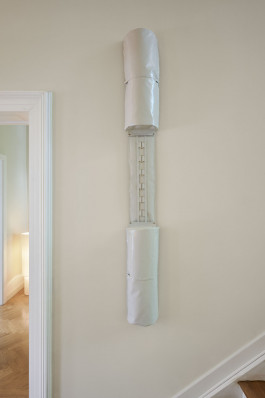
2Hz
2026
PVC
240 × 30 cm
Maja Günther
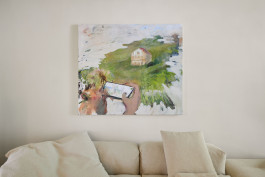
Ego-shooter
2026
Oil paint, oil pastels and coloured pencils on canvas
130 × 150 cm
Alissa Ritter
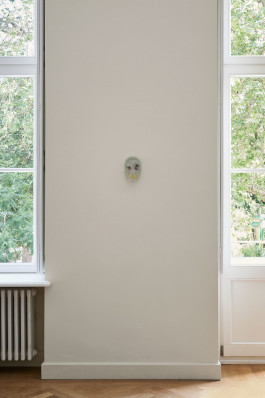
Bühnenschminke (Aftershow)
2025
Colored glass-fiber reinforced polyester resin
21 × 12 × 10 cm

Ricardo Passaporte
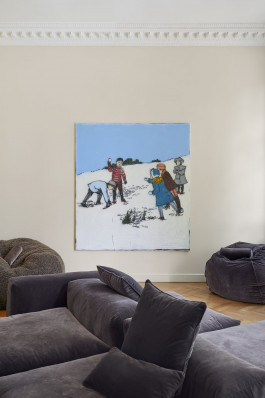
BTS 7
2024
Acrylic and spray paint on canvas
200 × 180 cm


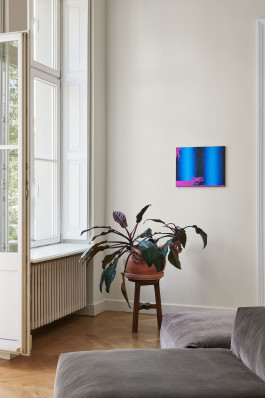
Kevin Lowenthal
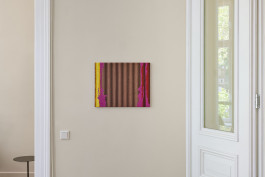
Cerulean curtain
2026
Oil on cotton canvas
41 × 51 cm

Kevin Lowenthal
Davy‘s Grey
2026
Oil on cotton canvas
41 × 51 cm

Hannah Sophie Dunkelberg
Baroque à la silhouette
2022
Polystyrol framed in walnut wood
100 × 50 × 3 cm

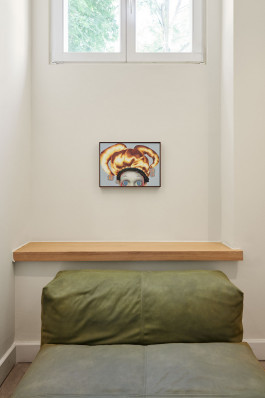
Diana Bloedorn
Doll 1/5
2026
Oil on canvas, wooden frame
41 × 56 cm


Diana Bloedorn
Doll 2/5
2026
Oil on canvas, wooden frame
32 × 44 cm

Stefan Marx
SUNRISE SUNSET
2025
Oil on canvas
65 × 50 cm

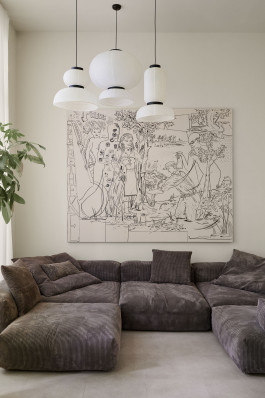
David Schiesser
Frischetheke
2025
Charcoal on canvas
200 × 250 cm

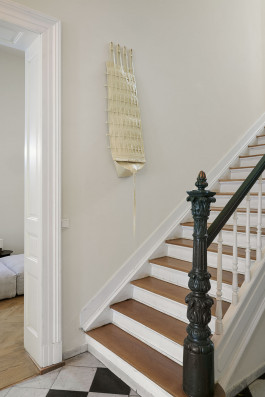
Paulina Hoffmann
Besatz
2026
PVC
140 × 40 cm

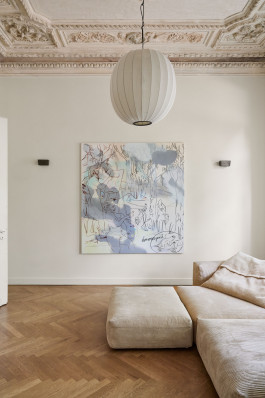
David Schiesser
Exxon Provence
2024
Acrylic, ink and charcoal on canvas
200 × 180 cm

Diana Bloedorn
*CCC* (Corndogs,Champions and Clown Ice Cream)
2025
Oil on canvas
30 × 42 cm

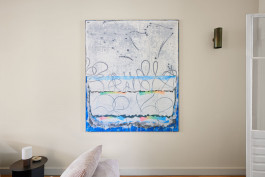
Arthur Löwen
Variation 32
2024
Acrylic on canvas
180 × 150 cm

Alissa Ritter
Bühnenschminke (Silver Spiral)
2025
Colored glass-fiber reinforced polyester resin
21 × 12 × 10 cm

Paulina Hoffmann
TfR_2
2024
PVC
40 × 140 cm
Fig Salad, Purple and Winking
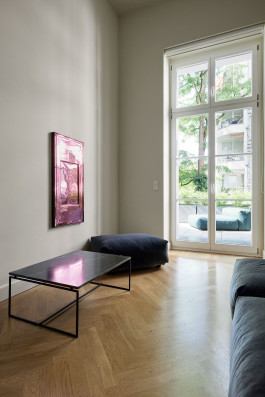
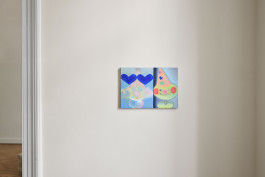
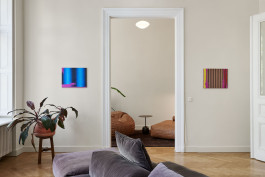
In Sylvia Plath’s The Bell Jar, the author describes the logic of decision-making by way of a fig tree. Imagining herself sat at its centre, each branch extends outward as a different possible life, each bearing a fig, and with it, a slightly different version of the future. As the branches stretch, they grow further out of reach of the others, creating a structure in which possibility and foreclosure are bound together. The logic of the niche is similar, suggesting both contingency and constraint – artistic practices honed to singularity. Within NICHE, collated by JVDW and hosted at vetsak, these branch-like trajectories fold back into relation. The exhibition brings together ten markedly disparate practices meaningfully in the context of vetsak’s flagship location, where the brand’s approach to space and modularity creates an architectural ecosystem in which texture, form, play, and rest intermingle. Here, it is as if the branches of Plath’s fig tree have bent inward – with different niches plaited and spread across two floors of a Gründerzeit Villa in Düsseldorf-Unterbilk with complex, playful topiary. Arthur Löwen’s paintings operate within the contextually significant register of the modular. Large canvases, predominantly blue and white, are built up through gradients, dramatic linear interventions, and frottage-like marks. There is a sense that the works should tessellate, but never quite do. The works are reminiscent of billboards that have been torn down and reapplied, fragments remaining. A related tension structures the paintings of Kevin Lowenthal, where the insistent use of the vertical is disrupted by horizontal flickers of paint. In his works, there is the sense of something architectural or chemical: corrugated iron fences, curtains, columns, balustrades, photographs developing, sonic hertz. Using a palette that ranges from CMYK tones to muted beige, his use of curtain-like motifs lend a sense of suspension.
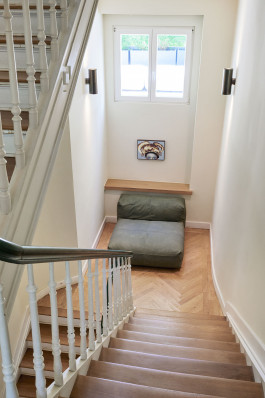
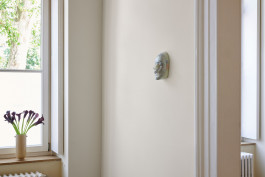
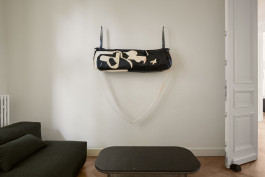
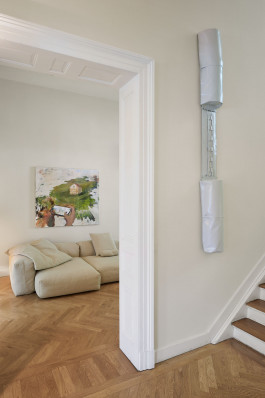
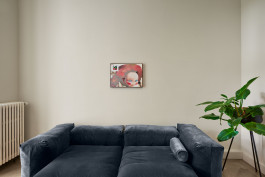
Both Hannah Sophie Dunkelberg and Paulina Hoffman position their practices in close proximity to manufacturing, form, and industry. Hoffman’s sculptural interventions operate within a utilitarian lexicon: bag-like PVC forms are pinned to the wall, woven, pleated, and suspended between states of function and display. Installed between floors, they take on a sentinel-like presence, quietly resisting the viewer’s expectation of use. Dunkelberg’s work, form-fitted and high-gloss, similarly reconfigures the language of industrial production. Through the incorporation of floral motifs, the artist unsettles the logic of packaging and containment, folding ornament back into systems typically governed by efficiency and standardisation. In other paintings, the concept of play emerges both thematically and aesthetically. Ricardo Passporte’s painting presents a stand-off between two groups of children, a snowball held aloft, a fight about to ensue. The mise-en-scene is rendered with a deftness that feels lifted from a children’s book, like Enid Blyton, or Tin Tin. Maja Gunther approaches play as mode rather than subject. In her work, a central figure playing on their phone is rendered in dense, swampy brushstrokes, set against a distant vision of a house. A change of register between the real and the digitised is marked by a change of medium on the phone screen. In both works, an uneasy tension lingers, complicating a straightforward reading. David Schiesser’s line drawings follow an associative logic, somewhere between a dream and a placard. Textual fragments – REWE, Frischetheke – punctuate a scene in which an escalator delivers disparate characters into bucolic ponds, and spatial relations are rendered unstable. Elements are layered and superimposed: train windows atop beach scenes, trees next to escalators. Small details escape the eye – an escalator leading to a scythe, figures swimming, fish piled up to be fed to a heron – creating a composition that balances reduction and excess. In Stefan Marx’ work, minimalism is central, with monochromatic, text-based motifs taking the fore. Fragments of interior monologues, inflected with the lexicon of pop culture lend a certain immediacy. The uncanny surfaces most clearly in the works of Alissa Ritter and Diana Bloedorn. Ritter’s fibre-glass faces seem to emerge from walls, their interiors bruised with colour. Eyes closed, lips parted, their faces calcified, inert and jellied. Similarly, Diana Bloedorn’s works turn on the doll and its associated registers of the cute and the uncanny. Powdery, polarised figures are cropped and framed with ambiguous expressions and exaggerated accessories: voluminous red hair, oversized jester hats, to disquieting effect. In both bodies of work, the contours of the familiar slip, resulting in something slightly molten, misshapen, and estranging the known. If the works in NICHE were to be charted on a graph (I imagine it would read x-axis: artist, y-axis, work) there would be no statistically significant conclusion to draw: the works remain stubbornly, insistently niche. And yet something holds them together: a shared immediacy, a sense of play, a tendency toward modularity, a sensitivity to contemporary image economies and their afterlives. Their niches are singular yet oblique, a series of overlaps and proximities, and in Plath’s words, perhaps: a fig salad, purple and winking.
Text: Lydia Earthy
Photography: Mareike Tocha
Groupshow
NICHE
May 8th – Jun 20th
2026


Paulina Hoffmann
2Hz
2026
PVC
240 × 30 cm

Maja Günther
Ego-shooter
2026
Oil paint, oil pastels and coloured pencils on canvas
130 × 150 cm
Alissa Ritter
Bühnenschminke (Aftershow)
2025
Colored glass-fiber reinforced polyester resin
21 × 12 × 10 cm

Ricardo Passaporte
BTS 7
2024
Acrylic and spray paint on canvas
200 × 180 cm


Kevin Lowenthal
Cerulean curtain
2026
Oil on cotton canvas
41 × 51 cm
Kevin Lowenthal
Davy‘s Grey
2026
Oil on cotton canvas
41 × 51 cm
Hannah Sophie Dunkelberg
Baroque à la silhouette
2022
Polystyrol framed in walnut wood
100 × 50 × 3 cm

Diana Bloedorn
Doll 1/5
2026
Oil on canvas, wooden frame
41 × 56 cm


Diana Bloedorn
Doll 2/5
2026
Oil on canvas, wooden frame
32 × 44 cm
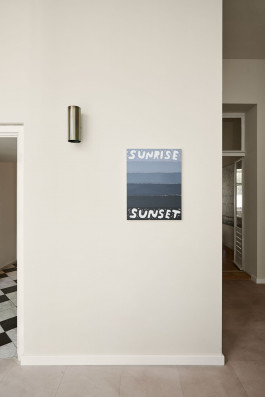
Stefan Marx
SUNRISE SUNSET
2025
Oil on canvas
65 × 50 cm
David Schiesser
Frischetheke
2025
Charcoal on canvas
200 × 250 cm

Paulina Hoffmann
Besatz
2026
PVC
140 × 40 cm
David Schiesser
Exxon Provence
2024
Acrylic, ink and charcoal on canvas
200 × 180 cm

Diana Bloedorn
*CCC* (Corndogs,Champions and Clown Ice Cream)
2025
Oil on canvas
30 × 42 cm
Arthur Löwen
Variation 32
2024
Acrylic on canvas
180 × 150 cm

Alissa Ritter
Bühnenschminke (Silver Spiral)
2025
Colored glass-fiber reinforced polyester resin
21 × 12 × 10 cm

Paulina Hoffmann
TfR_2
2024
PVC
40 × 140 cm
Fig Salad, Purple and Winking
In Sylvia Plath’s The Bell Jar, the author describes the logic of decision-making by way of a fig tree. Imagining herself sat at its centre, each branch extends outward as a different possible life, each bearing a fig, and with it, a slightly different version of the future. As the branches stretch, they grow further out of reach of the others, creating a structure in which possibility and foreclosure are bound together. The logic of the niche is similar, suggesting both contingency and constraint – artistic practices honed to singularity. Within NICHE, collated by JVDW and hosted at vetsak, these branch-like trajectories fold back into relation. The exhibition brings together ten markedly disparate practices meaningfully in the context of vetsak’s flagship location, where the brand’s approach to space and modularity creates an architectural ecosystem in which texture, form, play, and rest intermingle. Here, it is as if the branches of Plath’s fig tree have bent inward – with different niches plaited and spread across two floors of a Gründerzeit Villa in Düsseldorf-Unterbilk with complex, playful topiary. Arthur Löwen’s paintings operate within the contextually significant register of the modular. Large canvases, predominantly blue and white, are built up through gradients, dramatic linear interventions, and frottage-like marks. There is a sense that the works should tessellate, but never quite do. The works are reminiscent of billboards that have been torn down and reapplied, fragments remaining. A related tension structures the paintings of Kevin Lowenthal, where the insistent use of the vertical is disrupted by horizontal flickers of paint. In his works, there is the sense of something architectural or chemical: corrugated iron fences, curtains, columns, balustrades, photographs developing, sonic hertz. Using a palette that ranges from CMYK tones to muted beige, his use of curtain-like motifs lend a sense of suspension.
Both Hannah Sophie Dunkelberg and Paulina Hoffman position their practices in close proximity to manufacturing, form, and industry. Hoffman’s sculptural interventions operate within a utilitarian lexicon: bag-like PVC forms are pinned to the wall, woven, pleated, and suspended between states of function and display. Installed between floors, they take on a sentinel-like presence, quietly resisting the viewer’s expectation of use. Dunkelberg’s work, form-fitted and high-gloss, similarly reconfigures the language of industrial production. Through the incorporation of floral motifs, the artist unsettles the logic of packaging and containment, folding ornament back into systems typically governed by efficiency and standardisation. In other paintings, the concept of play emerges both thematically and aesthetically. Ricardo Passporte’s painting presents a stand-off between two groups of children, a snowball held aloft, a fight about to ensue. The mise-en-scene is rendered with a deftness that feels lifted from a children’s book, like Enid Blyton, or Tin Tin. Maja Gunther approaches play as mode rather than subject. In her work, a central figure playing on their phone is rendered in dense, swampy brushstrokes, set against a distant vision of a house. A change of register between the real and the digitised is marked by a change of medium on the phone screen. In both works, an uneasy tension lingers, complicating a straightforward reading. David Schiesser’s line drawings follow an associative logic, somewhere between a dream and a placard. Textual fragments – REWE, Frischetheke – punctuate a scene in which an escalator delivers disparate characters into bucolic ponds, and spatial relations are rendered unstable. Elements are layered and superimposed: train windows atop beach scenes, trees next to escalators. Small details escape the eye – an escalator leading to a scythe, figures swimming, fish piled up to be fed to a heron – creating a composition that balances reduction and excess. In Stefan Marx’ work, minimalism is central, with monochromatic, text-based motifs taking the fore. Fragments of interior monologues, inflected with the lexicon of pop culture lend a certain immediacy. The uncanny surfaces most clearly in the works of Alissa Ritter and Diana Bloedorn. Ritter’s fibre-glass faces seem to emerge from walls, their interiors bruised with colour. Eyes closed, lips parted, their faces calcified, inert and jellied. Similarly, Diana Bloedorn’s works turn on the doll and its associated registers of the cute and the uncanny. Powdery, polarised figures are cropped and framed with ambiguous expressions and exaggerated accessories: voluminous red hair, oversized jester hats, to disquieting effect. In both bodies of work, the contours of the familiar slip, resulting in something slightly molten, misshapen, and estranging the known. If the works in NICHE were to be charted on a graph (I imagine it would read x-axis: artist, y-axis, work) there would be no statistically significant conclusion to draw: the works remain stubbornly, insistently niche. And yet something holds them together: a shared immediacy, a sense of play, a tendency toward modularity, a sensitivity to contemporary image economies and their afterlives. Their niches are singular yet oblique, a series of overlaps and proximities, and in Plath’s words, perhaps: a fig salad, purple and winking.
Text: Lydia Earthy
Photography: Mareike Tocha